How it scales
Your business has its own logic. We model it.
Most AI tools flatten your business into a prompt. We don't. The ontology underneath Objeqt holds your customers, products, deals, regions, and rules — and updates as your business does. It's why the second module is cheaper than the first.
Not a database. Not a prompt. A model of how your business thinks.
A spreadsheet is a list. A database is rows with columns. An ontology is the structured understanding of what those rows and columns mean — and how they relate.
Customers have tier, region, contract history, salesperson relationship. Products have lifecycle, cost basis, margin floor. Deals connect customers to products at specific prices. A general AI pointed at your CRM export won't know that “Atlantic Dairy” and “Atlantic Dairy Partners GmbH” are the same customer, or that the margin floor moved last quarter for EMEA.
An ontology captures all of that — as data, not code. The output gets grounded; the reasoning gets auditable.
Four sources of truth. Honest about each.
Every property comes from one of four places. We label each so the reasoning stays auditable — and when data is missing, it's named as missing, not invented.
Derived
Computed from other data. Annual revenue = sum of last 365 days of quotes. The formula is shown.
Inferred
Pulled from unstructured sources by an LLM. Customer tier from sales notes. The source is linked. (coming soon)
Sourced
Pulled from an external system. Country, currency, ISO code. The source system is named.
Human input
Manually entered. Strategic account flag. The person and timestamp are recorded.
The differentiator
Your ontology is configured, not coded.
Most “ontology” tools require an engineer to make a change. Ours doesn't. The admin UI lets your commercial team add a property, change a rule, or refine a customer tier — without touching code.
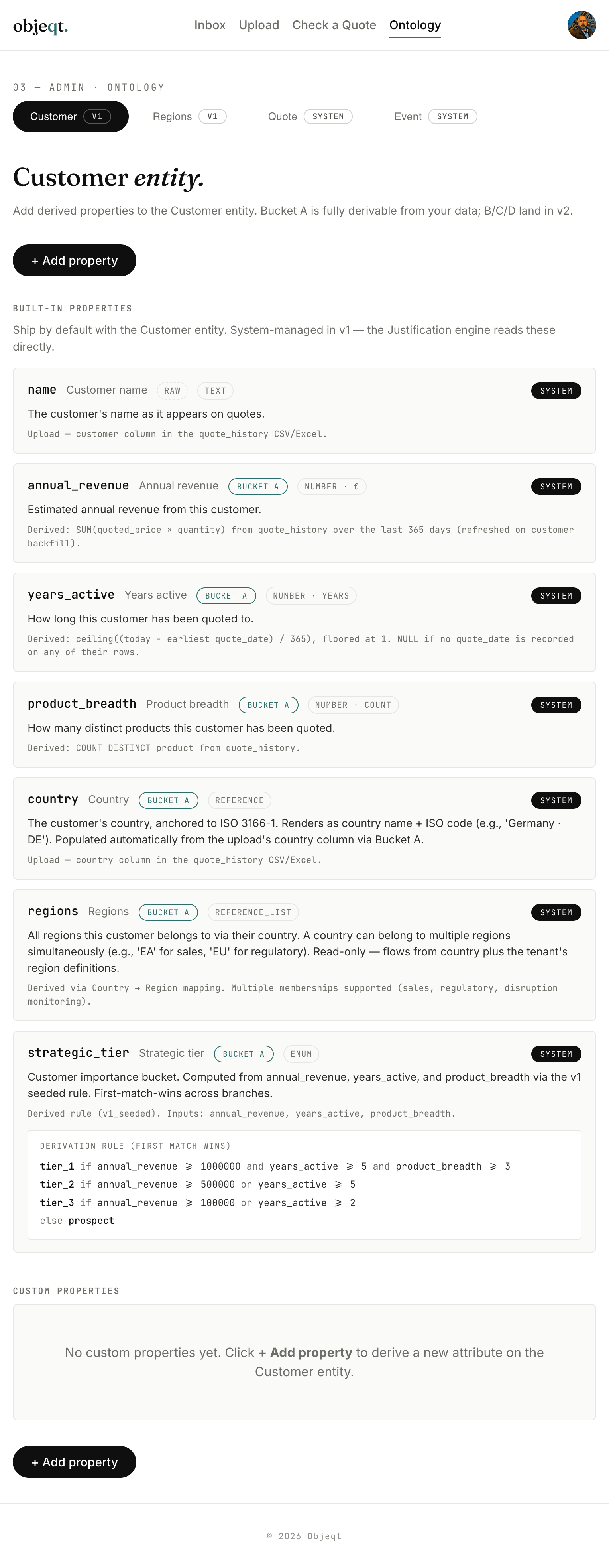
Each property declares its source. Each rule is visible. Each change is logged.
The second module is cheaper than the first.
Once the ontology exists for one domain, it's there for the next. Commercial Operations builds customer, product, and quote entities. The next module reuses them — same customer, same product, a different reasoning layer on top.
This is Palantir's architecture without Palantir's price tag. The same structured model of the business — but a product you configure in five days, not a $5M+ transformation program. The ontology comes pre-shaped for product-centric companies; you configure, not start from zero.
One of three things that make Objeqt possible.
The ontology models how your business thinks. The trust framework makes every claim auditable. And Compass points the whole thing at where you said you were going — your stated strategy, tracked against what actually happens.
Together they're the control plane: a model of your commercial world, every claim sourced, every decision scored against the plan.
See the ontology on your data.
A 30-minute walkthrough, with your customers, your products, your rules. By the end, you'll see how your business actually models inside Objeqt.