How AI earns its place
Every claim shows where it came from. Every decision teaches the system.
Trust in an AI tool isn't something you ask for. It's something the tool proves on every recommendation — every claim auditable, every value declaring its source, every decision feeding back into how the system reasons next time.
AI tools that hide their reasoning get audited out.
Most AI-assisted decision tools work like this: you ask a question, the model answers, you trust it or you don't. When you don't, there's nowhere to look. The number that came back is the number. The “why” is buried in weights you can't read.
For decisions that move margin, allocate capacity, or commit a customer relationship for two years, that isn't enough. Finance asks why the discount was approved at 14%. The CRO asks why this customer's tier was bumped. A tool that can't answer doesn't stop being used because of a policy — it stops because the people who tried it learned not to.
Every value in the system has a source.
The ontology defines what the business cares about; the provenance framework defines where each value comes from. Four categories, each with its own auditable trail.
Derived
Calculated from existing data via a rule. The formula, the inputs, and the timestamp are visible.
Inferred
Pulled from unstructured signals by an LLM. The source documents are linked; the confidence is shown.
Sourced
Fetched from an external system you connect. The system, the field, and the fetch time are recorded.
Human input
Defined by a person on your team. The person, the date, and the rationale are stored.
Click into any number and see which category it came from, what its inputs were, and when it was last updated. Nothing in the system is a black box.
Every approval, override, and reject teaches the system.
Objeqt records every decision your team makes — approve, override, reject, escalate — and feeds it back into the engine. Over time the system learns:
Which precedents your deal desk actually trusts, and which they routinely override.
Where your team's instinct diverges from the data's average.
Which customer segments are getting tighter or looser pricing than the rule suggested.
The system doesn't replace your judgment. It absorbs it. Six months in, the recommendations are shaped by every decision your team has already made — the operating manual of your business, not a replacement for it.
What trust looks like in practice
One Justification. Every claim sourced.
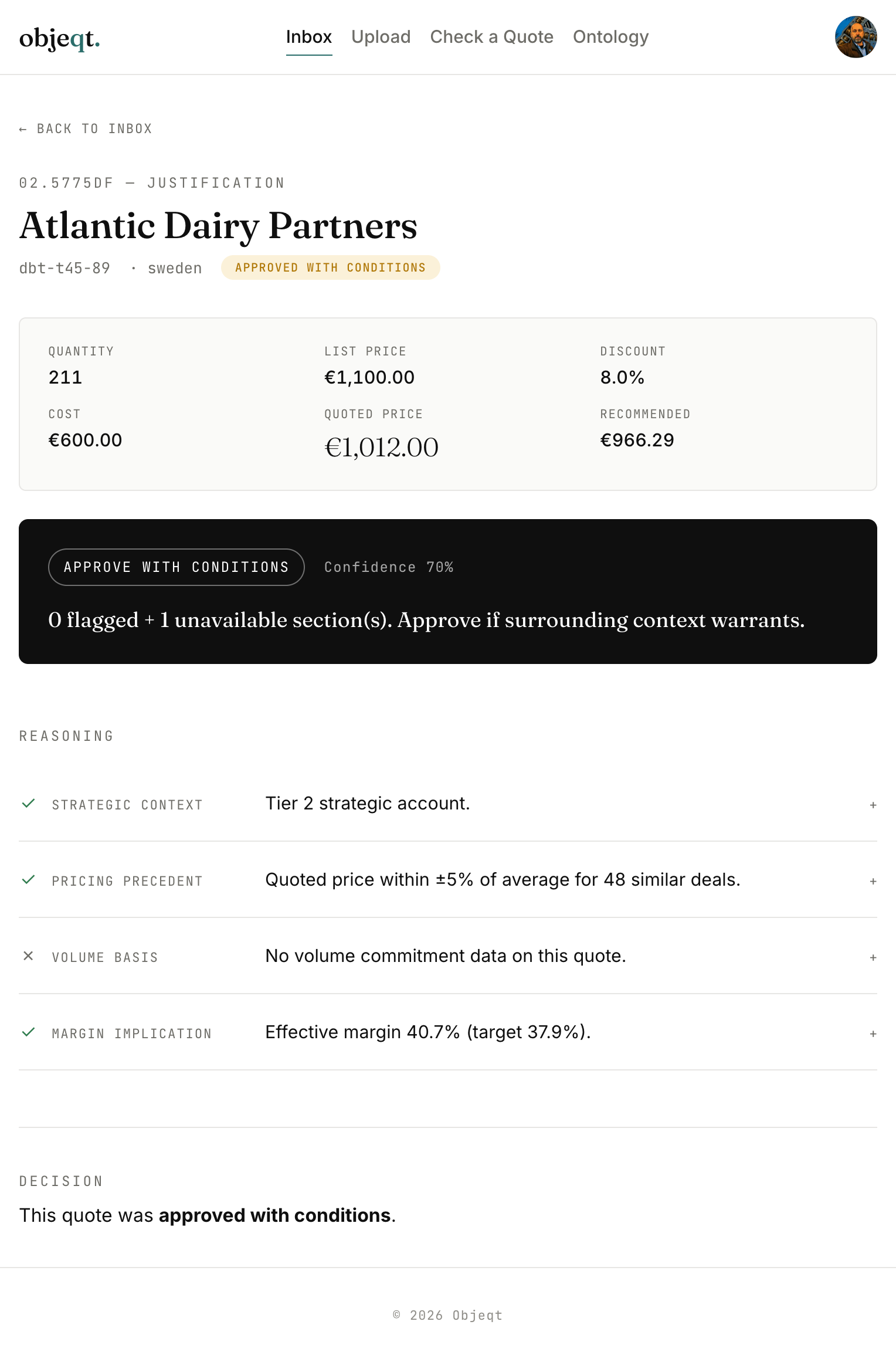
- Strategic context — Tier 2 strategic account. Source:
Customer.tier(Human input · set by Sarah J., 2026-04-12) - Pricing precedent — 14 similar deals, median €996. Source: Derived from
quote_history(product family + region, last 365 days) - Volume basis — No commitment data on this quote. Source: Missing — named, not invented
- Margin implication — 40.7% vs. target 37.9%. Source: Derived from
cost_basis+Customer.tierrules
If a value is missing, the artifact says it's missing — no invented numbers, no plausible-sounding guesses. Provenance is the unit of construction: the recommendation is generated from the trail, not the trail from the recommendation.
One of three things that make Objeqt possible.
The trust framework makes every claim auditable. The ontology models how your business thinks. And Compass points the whole thing at where you said you were going — your stated strategy, tracked against what actually happens.
Together they're the control plane: a model of your commercial world, every claim sourced, every decision scored against the plan.
See trust in your own decisions.
A 30-minute walkthrough. Bring a decision your team made recently. We'll show you what the reasoning trail would look like — sourced, learnable, defensible.